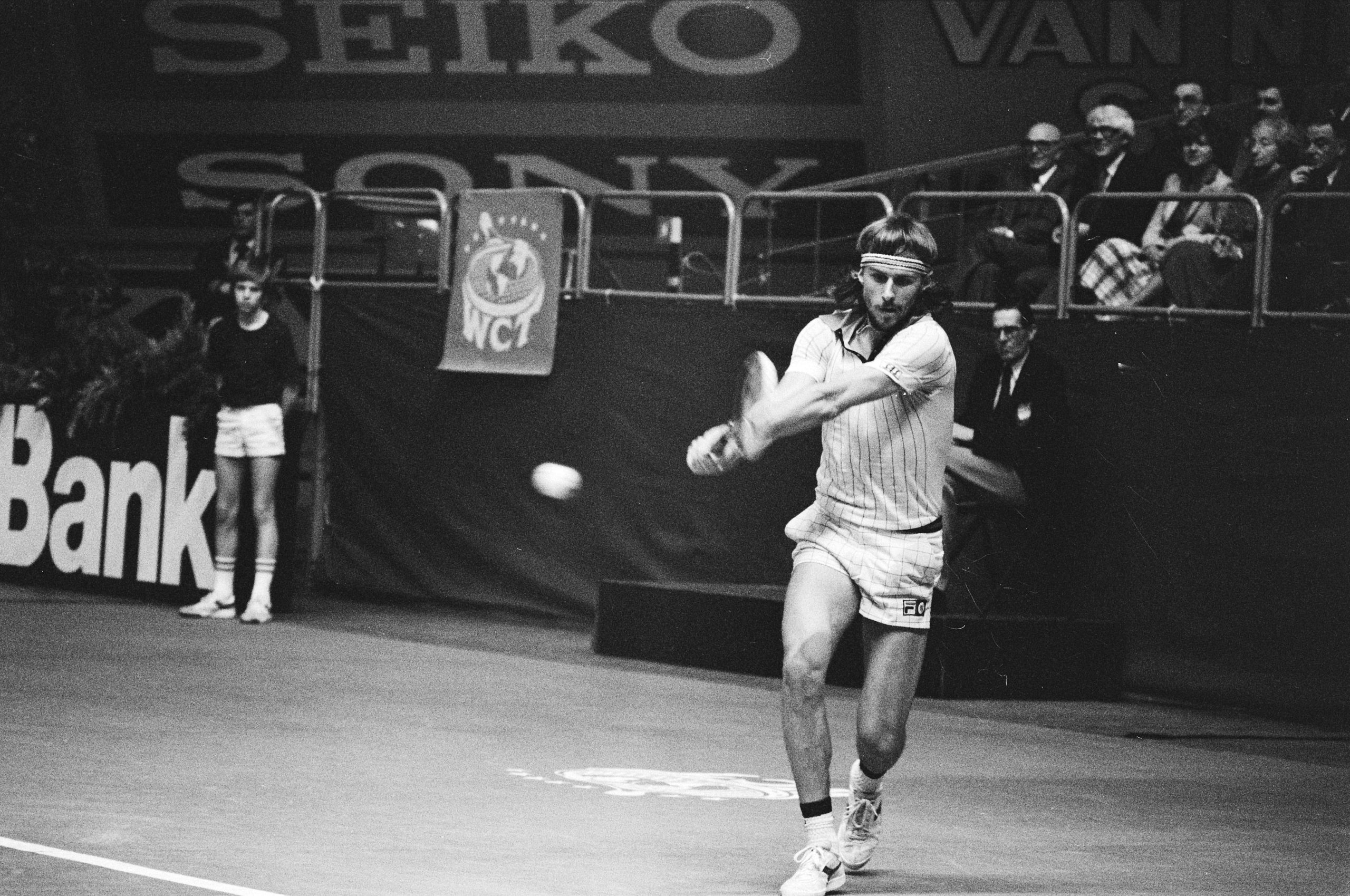
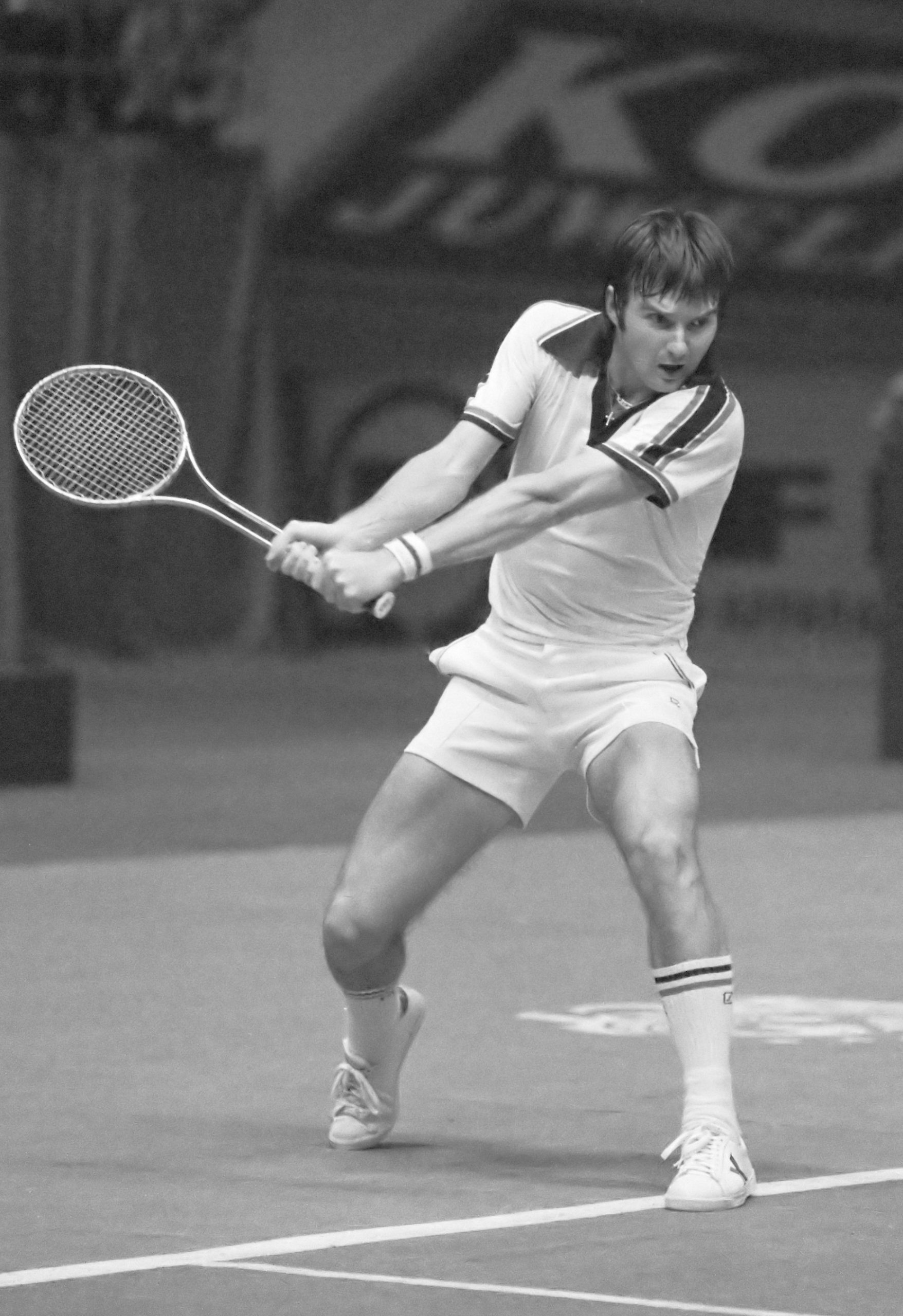
A wooden Donnay, a shining steel Wilson, a black-and-green Dunlop: sometimes a tennis racket can bring back an entire era before you have even read the name on its throat. Think of Björn Borg rolling a backhand from the baseline, Jimmy Connors taking a return early, or John McEnroe reaching forward to feather a volley. The equipment is part of the memory.
Yet tennis racket history is much more than a collection of famous brands. It is a story about materials, manufacturing, inventive stringing systems and the changing relationship between a player’s hand and the ball. The head became larger, the frame became lighter, and the possibilities for constructing a racket expanded enormously. Players did not all respond in the same way: some welcomed a new design, while others stayed with a trusted tennis racket long after the next generation appeared.
This guide follows that development from the ancestors of lawn tennis to the graphite frames and spin-focused designs of the modern game. Along the way, we look at the tennis rackets associated with Borg, Connors, Chris Evert, Arthur Ashe, Pam Shriver, Steffi Graf, Ivan Lendl, Pete Sampras, Andre Agassi, Roger Federer and Rafael Nadal.
Tennis racket history: a quick timeline
| Period | Tennis racket development | A useful example |
|---|---|---|
| Before the 1870s | Rackets develop within the older game of real tennis. | Wooden frames with shapes adapted to an indoor court game. |
| 1870s onwards | Lawn tennis spreads with wooden rackets and gut strings. | Wingfield’s commercially marketed lawn tennis sets. |
| Early to mid-20th century | Laminated construction refines the wooden tennis racket. | Dunlop Maxply and Wilson Jack Kramer families. |
| 1960s–1970s | Metal becomes a successful alternative to wood. | Connors’ steel Wilson T2000. |
| 1970s | Different materials coexist, and larger heads gain attention. | Ashe’s HEAD Competition and Shriver’s Prince Classic. |
| 1980s | Graphite composite frames become established. | Dunlop Max 200G, adidas GTX Pro and Wilson Pro Staff. |
| 1990s | Racket families cater to increasingly distinct playing identities. | Agassi’s HEAD Radical and Moyá’s Babolat Pure Drive. |
| Late 1990s onwards | Polyester strings help reshape the frame-and-string combination. | Kuerten’s polyester-strung racket at Roland-Garros in 1997. |
| 2000s onwards | Spin, customisation and the interaction between frame and strings become central themes. | Nadal’s AeroPro Drive association and Federer’s move to a 97-square-inch head. |
These periods overlap. A new material did not send every older tennis racket into retirement overnight. The 1970s and early 1980s are particularly interesting because champions could face each other with markedly different equipment.
Before lawn tennis: the origins of the tennis racket
The racket did not suddenly appear when lawn tennis became fashionable in the nineteenth century. The older indoor game now called real tennis already had a long equipment tradition. Its rackets provided the starting point for the first lawn tennis frames, but they had been shaped for a different setting and a different type of ball bounce.
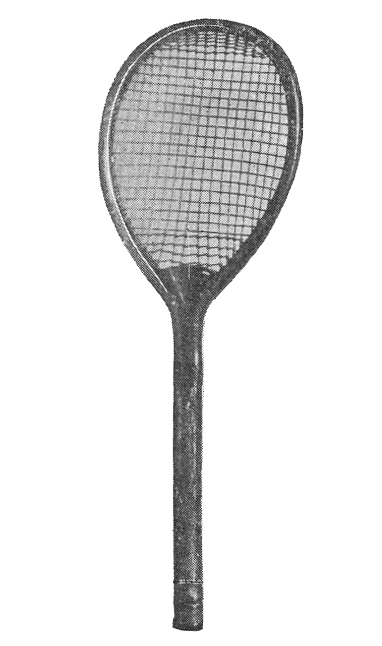
Early examples can look unfamiliar to anyone used to a symmetrical modern tennis racket. Some heads were distinctly lopsided. That was not simply careless workmanship: an asymmetrical head could help a player bring the hitting area closer to the ground in real tennis. As lawn tennis developed, symmetrical shapes became more common. The outline of the equipment was gradually adapting to the requirements of a new game. [1]
Major Walter Clopton Wingfield is a key figure in that transition, rather than the inventor of every part of tennis. He patented his version of lawn tennis in 1874 and marketed sets that helped people establish the game outside a permanent indoor court. The International Tennis Hall of Fame preserves examples of this early equipment culture, including a remarkably complete Jefferies lawn tennis boxed set. [2]
A useful way to picture the change is to imagine someone opening a box containing the essentials for a new leisure activity. The tennis racket was one component of a portable game. Its later identity as an individually specified, heavily marketed piece of sporting technology was still far away.
Why the wooden tennis racket lasted so long
For much of the sport’s history, a tennis racket meant a wooden frame, a leather-covered handle and a bed of strings. The silhouette became so familiar that it still serves as shorthand for vintage tennis today. A small oval head, a narrow throat and warm wood grain can communicate the period immediately.
Wood offered practical manufacturing advantages. Ash, in particular, combined useful strength and toughness with the ability to be bent into the required shape. Other timbers could contribute different properties in different parts of a frame. Over time, laminated construction allowed makers to combine thinner layers, improving consistency compared with relying on a single piece of naturally variable material. [3]
The important point is that a wooden tennis racket was not a primitive object that remained unchanged for a hundred years. Makers refined materials, adhesives, construction and finishing. Comparing an early lawn tennis frame with a mature twentieth-century laminated racket reveals a great deal of accumulated craft.
Laminated wood was technology too
It is tempting to divide tennis racket history into an old-fashioned wooden period and a scientific modern period. The distinction is too neat. Choosing layers, controlling grain direction and creating a frame that could retain its shape under string tension were engineering problems. The technology happened to involve wood rather than carbon fibre.
The ITF describes how mechanisation in the 1940s enabled manufacturers to use larger numbers of thinner veneers. This helped reduce the effect of wood’s natural variability. A tennis racket could still look traditional while benefiting from considerable manufacturing development. [3]
From wooden equipment to familiar names
The Dunlop Maxply became one of the enduring names of the wooden era. Research into historical frames records production of the Maxply over a period stretching from 1931 to 1983. The Wilson Jack Kramer Autograph was another influential example: the Hall of Fame holds one used by Chuck McKinley during the 1963 Davis Cup. [1] [4]
Those names also show how the relationship between tennis players and equipment companies developed. A tennis racket could become associated with a champion, a style of play or an aspiration. Someone buying a signature model was buying equipment, but also a small connection with the tennis they admired.
Björn Borg’s Donnay tennis racket: wood, topspin and a longer grip
Björn Borg is one of the clearest reminders that forceful baseline tennis did not begin with a modern graphite frame. His Donnay tennis racket belongs visually to the wooden era, yet his movement, topspin and two-handed backhand point towards much of the game that followed.
Donnay was a Belgian manufacturer with a substantial woodworking background. Europeana traces its tennis racket production to 1934 and describes its rise into a major international producer. Borg became the player most closely associated with its wooden frames during the 1970s. The partnership helped make the Donnay name recognisable far beyond Belgium. [5]
Was Borg’s tennis racket grip wider?
The detail to get right is length. The International Tennis Hall of Fame describes Borg’s Donnay as having a longer leather handle to accommodate his two-handed backhand. A grip extending farther up the handle provides room for the second hand. That is different from increasing the circumference of the handle, which is what players usually mean by a larger grip size. [6]
This distinction makes Borg’s tennis racket particularly interesting to look at. The grip is not merely an accessory added after the important work is finished. It is the point where a player’s technique meets the equipment. The same frame outline can feel very different when the available hand positions change.
Donnay was not the whole Borg racket story
Borg also used Bancroft rackets. The Hall of Fame’s 1977 “Bjorn Borg Personal” example is a Bancroft laminated wooden frame, and its catalogue explains the geographic distinction: Bancroft in the United States and Donnay in Europe. Reducing Borg’s entire career to a single logo would therefore miss part of the record. [7]
There is a good future article here: a closer examination of Borg’s Donnay and Bancroft tennis rackets, the visible grip differences and the photographs that document them. For this broader history, the central lesson is clear. A player could develop an unconventional game while still using a wooden tennis racket.
Jimmy Connors’ Wilson T2000: the steel tennis racket that stood out
If Borg’s wooden Donnay suggests grain, leather and dark paint, Jimmy Connors’ Wilson T2000 suggests exposed engineering. Its slender metal outline looks strikingly different from both a wooden tennis racket and a broad modern graphite frame.
The Wilson T2000 was a steel tennis racket, not an aluminium one. Its design is connected with René Lacoste, whose work helped solve an awkward problem in metal racket construction: how to support strings without exposing them directly to damaging metal edges. The T2000’s wire anchoring system is one of its distinctive identifying features. [8]
Why did the T2000 look so unusual?
Look around the outside of the head rather than concentrating only on the strings across its centre. The wire anchoring arrangement is part of the design, not decoration. A photograph of this area tells you more than the shiny finish alone. It is a useful example of how a change in frame material can force a change in the way the rest of a tennis racket is built.
Connors helped give that design a lasting identity. The Hall of Fame preserves a T2000 used by him at the 1983 US Open. It is a concrete reminder that the racket remained part of top-level competition well into the period when graphite frames were gaining ground. [8]
The Connors tennis racket story also prevents a misleadingly simple timeline. Tennis did not move from wood to metal to graphite in three tidy, non-overlapping steps. Familiarity, confidence and individual preferences mattered. An older construction could remain a champion’s trusted tool while the equipment market moved on around it.
Arthur Ashe and the HEAD Competition: another route beyond wood
Connors was not the only major player whose tennis racket reflected experimentation with new materials. Arthur Ashe’s association with HEAD offers a different route through the same period. The Hall of Fame identifies an “Arthur Ashe Competition 2” racket used in his 1975 Wimbledon championship victory. [9]
That example belongs in the story because it breaks the impression that every non-wooden tennis racket was simply another version of the T2000. Manufacturers explored different constructions and combinations of materials. There was no single replacement for wood that everyone immediately agreed upon.
The variety is part of the appeal of this era. Put a wooden Donnay, a steel Wilson and an Ashe-associated HEAD side by side, and you are looking at competing answers to the same design question. How can a tennis racket provide useful strength and playing characteristics without being limited by the traditional wooden form?
The oversize tennis racket: Prince changed the conversation
A new material was important, but so was a new amount of hitting area. The development of the oversize tennis racket made head size a central part of the equipment conversation. Instead of accepting the familiar small head as a fixed starting point, designers could ask what a substantially larger string bed might offer.
Howard Head received an American patent for an oversize tennis racket in 1976. The Prince Classic used an aluminium frame and brought the larger-head concept to a broad audience. It was an influential commercial development, although earlier experiments with larger heads mean it should not be described as the first large-headed racket ever imagined. [10] [1]
Pam Shriver made the Prince Classic impossible to ignore
In 1978, sixteen-year-old Pam Shriver reached the US Open final with a Prince Classic. The Hall of Fame uses that performance to illustrate the racket’s significance. An oversize tennis racket was no longer just something to discuss in a shop: a teenager was taking one deep into a major championship. [10]
The significance is easy to understand without pretending a larger head guarantees success. More hitting area changes the design possibilities, but the player still has to move, judge the ball and make decisions. The equipment can provide a different margin; it cannot decide where the next shot should go.
The graphite tennis racket: a change in what designers could build
The word “graphite” became one of the defining terms in tennis equipment. In this setting, it generally refers to carbon-fibre composite construction, rather than a frame carved from a solid lump of graphite. Fibres and resin work together as a structural material.
The manufacturing process matters. The ITF describes composite tennis racket construction using resin-impregnated sheets, layered with fibres in different directions, formed in a mould and cured using heat and internal pressure. Frame finishing, drilling, painting, grommets and the grip are further stages. A modern tennis racket is therefore the result of a construction process, not merely a material label. [11]
McEnroe and Graf: one tennis racket, contrasting games
The Dunlop Max 200G became closely associated with both John McEnroe and Steffi Graf. That pairing is fascinating because it resists the idea that every racket belongs to just one playing stereotype. Their tennis looked very different, yet the same model name forms part of both equipment histories.
The Max 200G also stands out for its manufacturing method. The Hall of Fame identifies it as the first graphite racket constructed using injection moulding, rather than the more familiar process of forming and compressing composite sheets. A museum can therefore tell two stories with it: one about famous champions and another about how an object was made. [12]
The historical attraction is not that the Max 200G “created” McEnroe’s touch or Graf’s forehand. It is that a specific tennis racket became a common object in two otherwise contrasting sporting pictures. Equipment influences possibilities, but it does not erase the individuality of the person holding it.
Ivan Lendl and the adidas GTX Pro
Ivan Lendl provides another landmark in the graphite era. The Hall of Fame records an adidas “Graphite GTX Pro” used in his 1984 French Open victory. The small-headed frame is a useful reminder that adopting composite materials did not always mean choosing an oversize tennis racket. [13]
Lendl’s equipment belongs to a period of expanding choice. Head size, construction and player preference could move in different directions. A collector who groups every graphite tennis racket together misses important distinctions between designs that happened to share a broad material category.
The Wilson Pro Staff tennis racket: from Evert to Sampras
Few tennis racket names have travelled through as many generations of the game as Pro Staff. However, the name does not identify one unchanging object. The wooden Wilson Pro Staff associated with Chris Evert and the later graphite-and-aramid Pro Staff family belong to different stages of equipment development.
The Hall of Fame holds the wooden “Pro Staff / Chris Evert” racket she used to win the 1982 US Open. Wilson dates the debut of its composite Pro Staff line to 1983 and describes its characteristic braided graphite and aramid construction. The shared branding is a reason to examine the actual frame, rather than assume a name tells the whole story. [14] [15]
Pete Sampras and the Pro Staff 85
Pete Sampras became strongly associated with the Wilson Pro Staff 85. The number refers to its nominal 85-square-inch head size. Compared with many later tennis racket designs, that is a compact hitting area. His continued association with it shows how a particular design can remain central to a player even as the wider market changes. [15]
For a historical article, that continuity matters as much as the launch of a new model. Progress does not always look like a champion reaching for the newest product. Sometimes the interesting story is the one they keep using. A familiar tennis racket can be part of a carefully rehearsed relationship between preparation, contact and expectation.
The 1990s: Agassi’s Radical and a new Babolat tennis racket
By the 1990s, distinctive racket families were becoming part of how fans recognised players. Colour schemes, names and frame shapes could be almost as memorable as clothing. The tennis racket was both sporting equipment and a powerful visual identity.
Andre Agassi and the HEAD Radical
HEAD developed the original Radical for Andre Agassi in 1993. Its black-and-yellow appearance earned the “Bumblebee” nickname, and HEAD’s history connects the racket with his 1994 US Open title. It is an example of a tennis racket whose visual personality became inseparable from the player associated with it. [16]
The Radical story also illustrates why a long-running product name needs careful handling. A racket family can evolve for decades. A modern model carrying the same name is not automatically identical to the frame seen in an old photograph, and a professional’s customised equipment is not always the shop version.
Carlos Moyá and the Babolat Pure Drive
Babolat’s history began with strings well before it became widely known for racket frames. The Pure Drive arrived in 1994. Carlos Moyá’s 1998 French Open victory gave the Babolat tennis racket a major championship breakthrough, helping establish the blue frame’s place in equipment history. [17]
The Pure Drive’s later associations with players including Andy Roddick and Kim Clijsters helped make it another recognisable racket family. Its story is different from the Pro Staff’s or the Max 200G’s, but the wider theme is familiar: a tennis racket becomes culturally significant when people can connect the object with memorable tennis.
A tennis racket is also a string bed: the quieter revolution
Frames receive much of the attention because they carry the visible brand and model name. But the ball meets the strings. A history that ends at the painted frame is missing a substantial part of the equipment.
Babolat dates its first tennis strings to 1875, placing natural gut near the beginning of lawn tennis itself. Later synthetic strings expanded the available choices. For a closer look at the different string families, see our tennis string guide and explanation of natural gut tennis strings. [18]
The spaghetti tennis racket controversy
The late-1970s “spaghetti” stringing controversy showed how dramatically a string arrangement could change a racket’s behaviour. Unconventional systems allowed extensive string movement and unusually high spin. The ITF’s technical history connects the subsequent rule changes with the requirement for a conventional crossing string pattern. [19]
The important distinction is that this was not simply a strangely shaped tennis racket. The disruptive idea lay in the stringing system. A fairly familiar-looking frame could contain something radically different. It is an excellent reminder to look beyond the silhouette.
Kuerten and the polyester turning point
Gustavo Kuerten’s 1997 French Open victory is another significant moment in the string story. Luxilon supplied his polyester strings, and the win brought attention to a setup that would become influential in the modern game. Describing this as a frame-only revolution would miss the point. [20]
There is no need to claim that a string invented Kuerten’s talent or that every recreational player should copy a professional setup. The historical point is that tennis racket development increasingly concerned a combination: the player, the frame, the strings and the way they were prepared for play.
Federer, Nadal and the modern tennis racket
By the twenty-first century, tennis racket design had inherited several earlier revolutions. Composite construction, more varied head sizes and specialised string choices were no longer isolated novelties. Manufacturers could refine those elements around different playing priorities.
Roger Federer: from smaller heads to the RF97
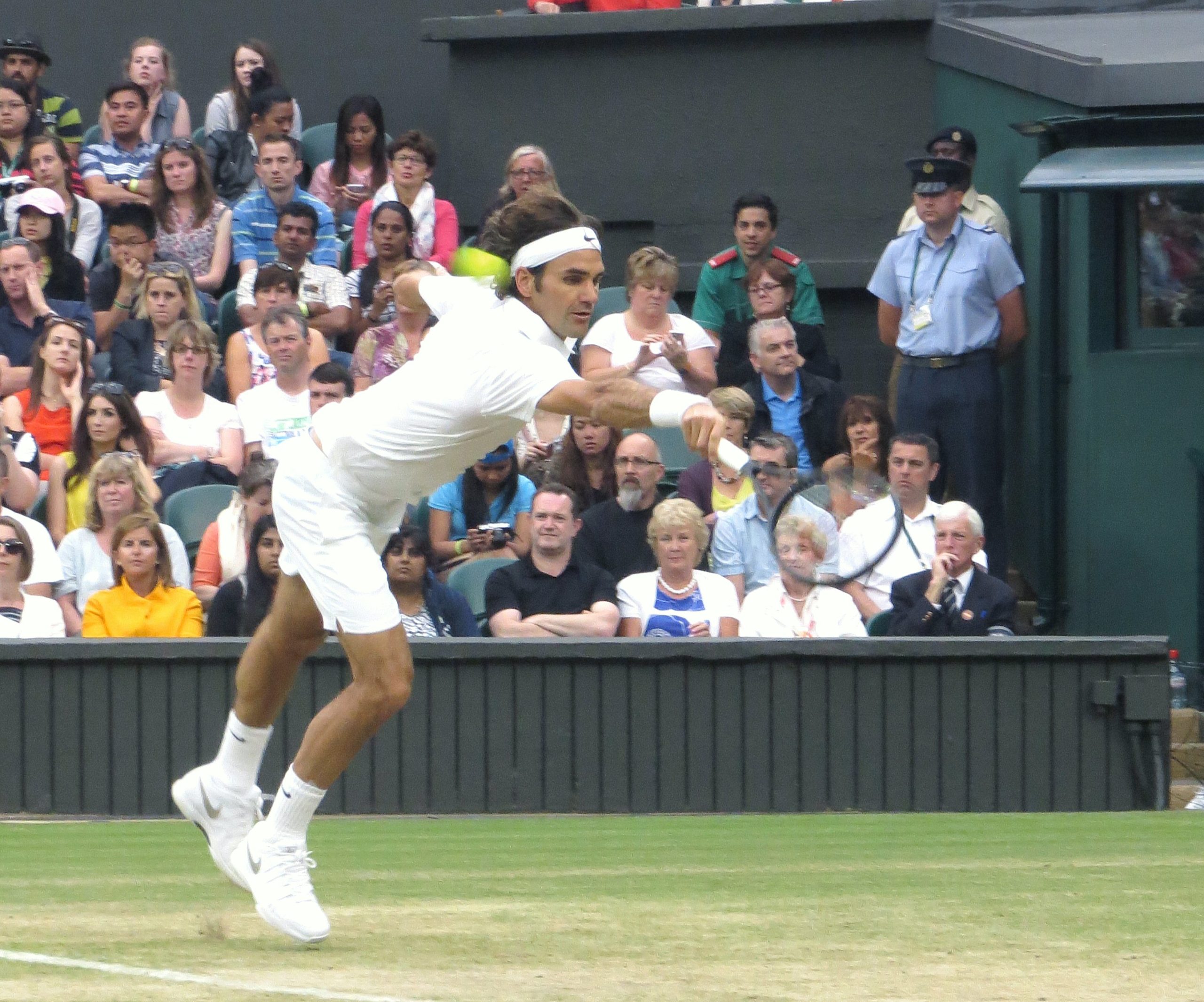
Roger Federer’s Wilson history connects the compact-head tradition with a later move towards a larger hitting area. Wilson records his progression through nominal 85-, 90- and 97-square-inch head sizes, with the 97 arriving in 2014. The RF97 became a notable chapter in the development of his tennis racket equipment. [15]
It would be too simple to attribute a later match result to that change alone. What makes it interesting historically is the willingness of an established champion to alter something so familiar. Even at the highest level, the relationship between a player and a tennis racket is not necessarily fixed forever.
Rafael Nadal and the AeroPro Drive
Babolat dates its work with Nadal on the AeroPro Drive to 2004. The company describes an aerodynamic design intended to support racket-head speed and spin production. The racket’s association with Nadal made it a particularly recognisable example of the modern spin-focused tennis racket. [21]
Again, the equipment is part of a larger picture. Nadal’s physical preparation, movement and stroke production cannot be reduced to a frame shape. The more useful historical connection is between a player’s requirements and the direction in which a manufacturer developed and presented its equipment.
Why the paint does not tell the entire story
Professional tennis rackets can be customised, and an endorsement does not guarantee that a player uses an unchanged retail model. Babolat explicitly notes this distinction on its Pure Drive history page. A photograph can establish what a racket looked like on a particular day; it may not establish its precise internal construction or specifications. [17]
This is especially important when comparing tennis racket generations. Model names, cosmetics and the actual frame underneath should be recorded separately whenever possible. It makes the difference between a useful equipment history and a list of logos.
Wooden tennis racket versus modern tennis racket: what really changed?
The overall direction is clear: modern composite designs made it possible to combine a larger hitting area with less mass than many traditional wooden frames. The ITF describes typical modern rackets as substantially lighter, with larger string areas. Those are broad comparisons across equipment generations, not specifications for every individual racket. [22]
| Feature | Traditional wooden tennis racket | Modern composite tennis racket |
|---|---|---|
| Construction | Timber, often in bonded layers. | Fibre-and-resin composite construction. |
| Head shape and size | Generally a smaller hitting area in mature twentieth-century designs. | A wider choice of larger heads and frame geometries. |
| Design freedom | Strongly influenced by the properties and limitations of wood. | More scope to vary lay-up, cross-section and mass distribution. |
| Visual clues | Wood grain, laminations, narrow sections and period decals. | Broader structural variety; cosmetics may hide construction details. |
| Historical appeal | Direct connection with the long wooden era and its craftsmanship. | A record of the material, head-size and string developments that followed. |
One point deserves emphasis: weight alone does not describe how a tennis racket feels to swing. The distribution of that weight matters too. Likewise, head size alone cannot tell you everything about control, comfort or suitability. Reading a racket as a combination of properties is more useful than looking for one winning number.
The evidence for the long-term transformation is stronger than a handful of nostalgic examples. A 2019 study by Taraborrelli and colleagues examined 525 historical rackets dating from 1874 to 2017. It linked changes in materials with changes in the physical designs of the frames. That offers a research-based foundation for the history, alongside museum objects and manufacturers’ records. [1]
Famous tennis players and their tennis rackets
This table identifies selected historical associations, rather than claiming each player used only one racket throughout an entire career.
| Player | Selected tennis racket association | Why it belongs in the history |
|---|---|---|
| Chuck McKinley | Wilson Jack Kramer Autograph | A documented example of the wooden signature-model era. |
| Björn Borg | Donnay wooden frames; Bancroft in the United States | Wooden equipment, topspin and the longer grip for two hands. |
| Jimmy Connors | Wilson T2000 | Steel construction with a distinctive string anchoring system. |
| Arthur Ashe | HEAD Arthur Ashe Competition 2 | A notable alternative to traditional wood in the 1970s. |
| Pam Shriver | Prince Classic | Oversize visibility at the 1978 US Open. |
| Chris Evert | Wooden Wilson Pro Staff / Chris Evert; later composite Pro Staff | A career spanning the change between equipment generations. |
| John McEnroe | Dunlop Max 200G | A celebrated association with an injection-moulded graphite frame. |
| Steffi Graf | Dunlop Max 200G | The same model name linked with a very different playing style. |
| Ivan Lendl | adidas Graphite GTX Pro | A compact-headed example of the graphite era. |
| Pete Sampras | Wilson Pro Staff 85 | A lasting association with a compact composite frame. |
| Andre Agassi | HEAD Radical | A recognisable racket family launched for him in 1993. |
| Carlos Moyá | Babolat Pure Drive | Babolat’s first racket Grand Slam breakthrough in 1998. |
| Roger Federer | Wilson Pro Staff family and RF97 | A visible progression in preferred head size. |
| Rafael Nadal | Babolat AeroPro Drive association | A defining example of spin-focused racket development. |
How to look at an old tennis racket
An old tennis racket can be interesting even if you never plan to play with it. Start by treating it as an object with clues, rather than assuming that a familiar signature proves it belonged to that player.
Separate the model name from the player’s ownership
A signature printed on thousands of retail frames is part of a model’s branding. It is not the same as a handwritten autograph, and neither automatically proves match use. If a racket is claimed to be a player’s actual equipment, the useful question is what documentation connects that individual object with a match or period.
Look beyond the front face
Photograph the throat, side profile, handle, butt cap and any surviving labels. On a T2000, examine the string anchoring arrangement. On a wooden tennis racket, look at the laminated edges and the length of the leather grip. These details can make the object much more informative than a single front-on picture.
Record what you know, and what you do not
A useful record might say “Donnay model, approximate period, replacement grip” rather than assigning a precise year without evidence. Cosmetic changes, later restringing and replacement parts can complicate identification. Leaving an uncertainty visible is better than turning a guess into a historical fact.
For someone following this history, that detective work is part of the enjoyment. A tennis racket can connect a manufacturing process, a player’s technique and a familiar tournament photograph. The most interesting examples often raise the next question rather than settling every detail.
Tennis racket history: frequently asked questions
Who invented the first tennis racket?
There is no single inventor of every racket used across tennis’s long history. Rackets existed in real tennis before lawn tennis emerged. Wingfield’s 1874 patent is important to the commercial spread of lawn tennis, but it should not be confused with inventing the racket from nothing.
When did players stop using wooden tennis rackets?
The transition happened gradually. Wood remained important through the 1970s, and the ITF records quantity production into the early 1980s. Evert’s wooden racket from her 1982 US Open victory is a particularly clear example of wood remaining competitive during the change.
What tennis racket did Björn Borg use?
Borg is famously associated with wooden Donnay rackets, but he also used Bancroft equipment in the United States. The Hall of Fame documents a 1977 Bancroft “Bjorn Borg Personal” racket. His Donnay association is central to the story, but it is not the only part.
Why did Borg have a longer tennis racket grip?
The longer leather grip accommodated his two-handed backhand. Grip length and grip thickness are different measurements: extending the wrapped area up the handle does not automatically mean the handle’s circumference was larger.
Was Jimmy Connors’ Wilson T2000 aluminium?
No. The Wilson T2000 associated with Connors was a steel tennis racket. Its distinctive wire string anchoring system is a useful identifying feature. Aluminium belonged to other important designs, including the Prince Classic.
Was the Dunlop Max 200G only a McEnroe tennis racket?
No. It is also strongly associated with Steffi Graf. Its significance includes both those player connections and its unusual injection-moulded graphite construction.
Why did tennis racket heads become bigger?
New constructions made larger heads more practical. The oversize movement made hitting area a major design choice, while composite frames expanded the possibilities further. The history is about both materials and geometry, rather than one invention doing everything.
Is a graphite tennis racket made entirely from graphite?
The term usually describes a carbon-fibre composite frame. Fibres are combined with resin, and other materials may also be present. The word on the frame is therefore a broad material description, not a complete manufacturing recipe.
Are “tennis racket” and “tennis racquet” different things?
In ordinary tennis usage, both spellings refer to the same piece of equipment. Brands, museums and publications vary in their preferred spelling. When identifying a historical model, its manufacturer, date and construction matter more than that spelling difference.
Does a famous player use exactly the tennis racket sold in shops?
Not necessarily. Professional equipment can be customised or differ from the retail model being promoted. A reliable player-equipment history should distinguish an endorsement, a visible paint scheme and the documented specifications of an individual frame.
The tennis racket is a history of changing possibilities
The wooden tennis racket was not simply replaced by a better-looking version of the same object. Steel challenged the familiar material, oversize designs challenged the familiar hitting area, and composites changed what manufacturers could construct. String developments then added another powerful layer to the story.
Borg’s longer grip, Connors’ T2000, Shriver’s Prince Classic and Federer’s changing head sizes make those developments easier to see. Each connects an object with a particular moment in the game. Together, they show that tennis racket history is both a history of invention and a history of players finding equipment they could trust.
Want to explore the equipment in more detail? Continue with our tennis racket questions and answers, browse the tennis equipment articles, or read about the strings inside your tennis racket.
Sources and further reading
This overview draws on museum catalogue entries, the ITF’s technical resources, historical research and manufacturers’ own product histories. A player’s association in this article describes the documented period or model discussed; it is not a complete inventory of every frame used throughout their career.
- Taraborrelli, L., Grant, R., Sullivan, M., Choppin, S., Spurr, J., Haake, S. and Allen, T. (2019), Materials Have Driven the Historical Development of the Tennis Racket, Applied Sciences, 9(20), 4352. Also available through the Sheffield Hallam University Research Archive.
- International Tennis Hall of Fame: Major Walter Clopton Wingfield and Royal Lawn Tennis Boxed Set.
- International Tennis Federation: History of Rackets and Strings.
- International Tennis Hall of Fame: Chuck McKinley’s Jack Kramer Autograph.
- Europeana: Donnay: how a Belgian company became the world’s largest tennis racket maker.
- International Tennis Hall of Fame: Björn Borg biography, including the longer leather handle.
- International Tennis Hall of Fame: Bancroft Bjorn Borg Personal.
- International Tennis Hall of Fame: Jimmy Connors’ T2000.
- International Tennis Hall of Fame: Arthur Ashe Competition 2.
- International Tennis Hall of Fame: Pam Shriver and the Prince Classic.
- International Tennis Federation: Racket Manufacture.
- International Tennis Hall of Fame: Stefanie Graf’s Max 200G. See also the Museum of Design in Plastics catalogue for the McEnroe and Graf associations.
- International Tennis Hall of Fame: Ivan Lendl’s Graphite GTX Pro.
- International Tennis Hall of Fame: Chris Evert’s wooden Pro Staff.
- Wilson: The History of the Wilson Pro Staff Tennis Racket.
- HEAD: The History of the HEAD Radical Series.
- Babolat: Pure Drive 30th Anniversary.
- Babolat: 150 Years of History.
- International Tennis Federation: Strings.
- Luxilon: Celebrating International Tennis Day: How Luxilon Drives Tennis Forward.
- Babolat: Pure Aero Rafa history.
- International Tennis Federation: Rackets.


