


The 2026 Rolex Paris Masters is almost here. With qualifying beginning on 31 October and the main draw running from 2–8 November, Paris offers one last Masters 1000 contest before the season-ending championship. There is a substantial prize fund, a draw full of contrasting playing styles and a roll of honour that mixes dominant champions with memorable outsiders. Here is our guide to the week, the money and the tennis worth watching.
Preview published 31 October 2026. Schedules and player participation can change; check the official daily order of play.
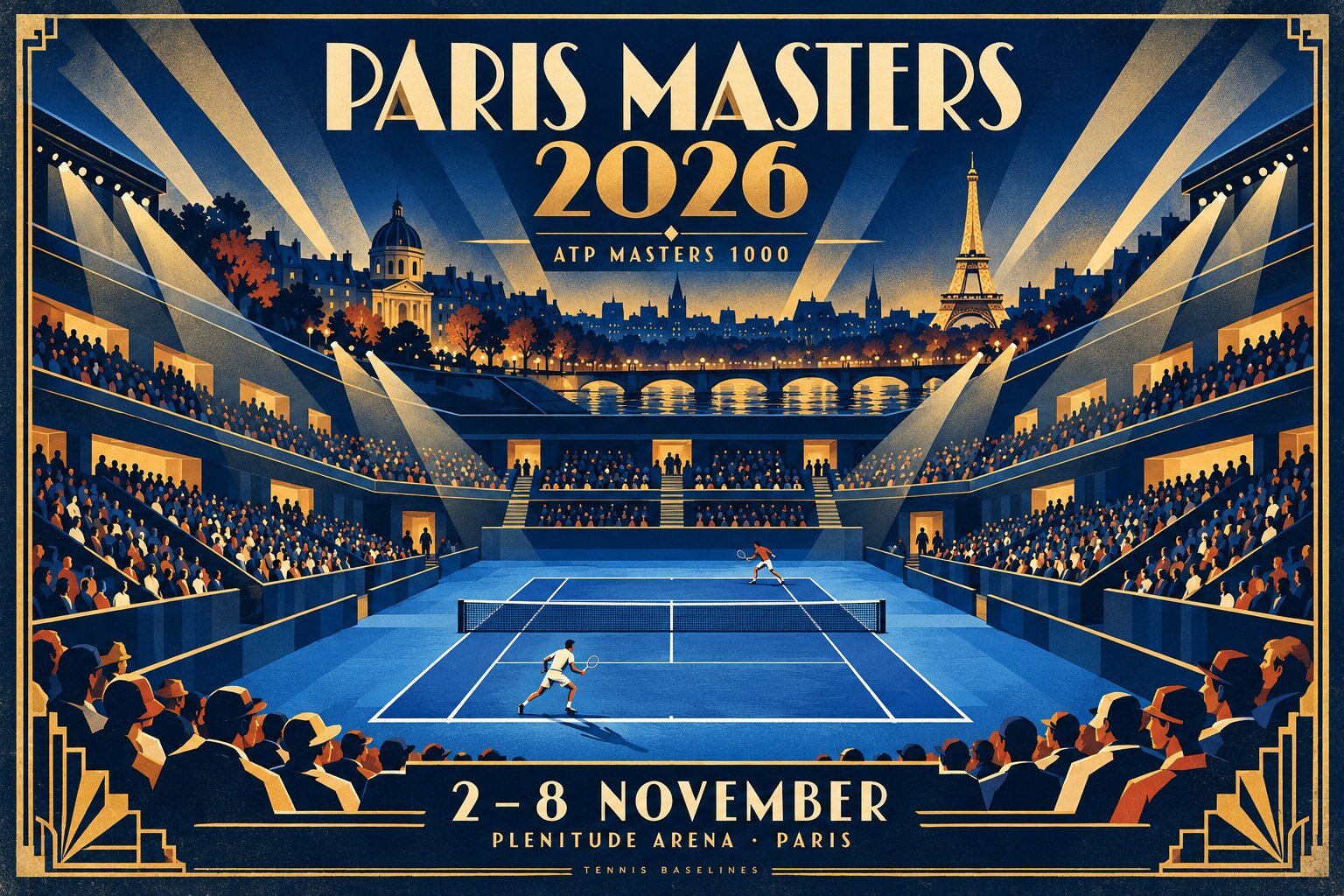
Paris Masters 2026: the essentials
The event is the ninth and final ATP Masters 1000 tournament of the season. It is played on indoor hard courts, with a 56-player singles draw. The tournament moved away from its long-standing Bercy home in 2025. For 2026, the organiser uses the venue name Plenitude Arena, the arena previously known as Paris La Défense Arena. This is a different setting from the clay courts of Roland-Garros: Paris hosts both events, but they ask very different questions of the players.
The tournament is also celebrating its fortieth anniversary. That gives the week a historical backdrop, although the most interesting story will still be what happens between the lines. Indoor tennis removes wind from the equation and can put the spotlight on serve placement, return positioning and the ability to take time away from an opponent.
Dates and provisional schedule
The organiser’s provisional programme gives fans a clear route through the week. The times below are local Paris time, which is also the time in the Netherlands during this tournament. A session start is not a guaranteed start time for a particular player.
| Date | Scheduled stage |
|---|---|
| 31 October–1 November | Qualifying, from 11:00 |
| 2–4 November | Opening singles rounds and doubles |
| 5 November | Singles round of 16 |
| 6 November | Singles quarter-finals |
| 7 November | Singles semi-finals |
| 8 November | Doubles final at 12:30; singles final scheduled for 15:00 |
A wheelchair tennis competition runs alongside the closing weekend, from 6–8 November. Anyone planning a visit should consult the official tournament programme and the latest order of play before making arrangements.
The draw: familiar champions and awkward opening matches
Alexander Zverev and Carlos Alcaraz occupy opposite ends of the draw as the first and second seeds. Zverev, the 2024 champion, could begin against Lorenzo Musetti or Hubert Hurkacz. Alcaraz awaits either Jiri Lehecka or Alex Michelsen. Neither opening looks like a match to treat as a gentle warm-up.
Seven-time Paris champion Novak Djokovic has a first-round meeting with Valentin Vacherot. Other opening matches highlighted by the organiser include Learner Tien against Stefanos Tsitsipas and Tommy Paul against Holger Rune. These are confirmed draw pairings, rather than predictions of who will progress.
If the seedings hold, the projected quarter-finals are Zverev–Alex de Minaur, Ben Shelton–Frances Tiafoe, Flavio Cobolli–Daniil Medvedev and Arthur Fils–Alcaraz. Tennis rarely follows a printed bracket perfectly, so these potential meetings are best treated as storylines to follow, not fixtures already in the diary. The official draw report provides the full context.
Will the defending champion return?
Jannik Sinner won the 2025 singles title, but the organiser’s updated entry-list report says he will not defend it in 2026 after ending his season because of a knee injury. That guarantees a different champion this year. It also makes it especially important to distinguish a list of past champions from the current entry list: winning last year’s event does not automatically mean a player is taking part this week.
For the home crowd, Fils and 2024 finalist Ugo Humbert offer two obvious names to follow. We would resist declaring a favourite solely on nationality, reputation or crowd support. The better guide will be how comfortably each player handles his first service games and how often he creates pressure on return.
Paris Masters 2026 prize money
The LTA’s current preview lists a total tournament prize fund of €6,309,095. The reported singles prize-money distribution is shown below. These are the reported amounts for the finishing round, not payments to add together for every round a player completes.
| Singles result | Reported prize money |
|---|---|
| Champion | €974,370 |
| Runner-up | €532,120 |
| Semi-finalist | €290,960 |
| Quarter-finalist | €158,700 |
| Round of 16 | €84,890 |
| Round of 32 | €45,520 |
| First round | €25,220 |
The champion also earns 1,000 ranking points. Prize money and ranking points measure different things: one is the financial reward, while the other contributes to a player’s standing. The figures above are published gross awards, rather than an estimate of a player’s personal take-home income.
Recent Paris Masters winners: 2016–2025
The last ten singles finals show why Paris rewards both established champions and a player who finds an exceptional week of form. This list follows the tournament’s official anniversary history.
| Year | Champion | Runner-up |
|---|---|---|
| 2025 | Jannik Sinner | Félix Auger-Aliassime |
| 2024 | Alexander Zverev | Ugo Humbert |
| 2023 | Novak Djokovic | Grigor Dimitrov |
| 2022 | Holger Rune | Novak Djokovic |
| 2021 | Novak Djokovic | Daniil Medvedev |
| 2020 | Daniil Medvedev | Alexander Zverev |
| 2019 | Novak Djokovic | Denis Shapovalov |
| 2018 | Karen Khachanov | Novak Djokovic |
| 2017 | Jack Sock | Filip Krajinovic |
| 2016 | Andy Murray | John Isner |
Djokovic holds the tournament record with seven singles titles. Yet the variety in this table matters too. Sock, Khachanov and Rune each collected their first Masters 1000 title in Paris. For a viewer, that history is a useful reason to watch beyond the biggest names: an early-round match can become the start of the week’s defining run.
Our viewing guide: three tactical details to watch
First, watch where the serve goes, not simply how fast it travels. A serve aimed into the body can deny a returner a clean swing. A wide delivery can open the court for the next shot, but it also leaves space if the returner anticipates it. During the first few service games, look for patterns on important points. Does a player repeat his safest location at 30–30, or change direction when the receiver begins to lean?
Second, follow the returner’s starting position. Standing back creates more time, but it can leave a player chasing the next ball from a defensive position. Moving forward asks for a shorter reaction and a more compact swing. There is no single correct answer for every matchup. The fascinating part is seeing whether the server changes pace and placement when an opponent adjusts. A return that lands deep through the middle can be more effective than a spectacular attempt at a clean winner.
Third, notice who controls the first neutral rally ball. A match can look serve-dominated while actually turning on the next exchange. One player may consistently land the first groundstroke close to the baseline, forcing a short reply. The other may find enough height and depth to reset the point. Watch the court position after four shots: it often explains pressure more clearly than the speed of an isolated forehand.
These are our tactical observations to look for, rather than claims about a measured court-speed rating for this year’s event. They also translate well to club tennis. You do not need a professional serve to benefit from a clear target, an organised first ball and a return plan that suits your own reaction time.
Do not overlook the doubles
Doubles offers another way to read the same court. Pay attention to how the net player reacts before the return is struck, and how partners cover the space after a wide serve. A successful interception often begins with an agreed pattern rather than a last-second burst of inspiration. For club players, that makes doubles an especially useful part of the programme: you can borrow the decision-making without trying to copy professional power.
Our practical doubles tactics guide explains some of those shared decisions. If a close set reaches 6–6, our tie-break rules guide is a useful companion for following the serving sequence.
What would make this a memorable Paris week?
A great tournament needs more than an impressive final. It needs opening matches that challenge expectations, contrasting approaches to the same conditions and players who solve problems as the week progresses. Paris has all the ingredients for that sort of viewing. Pick one section of the draw to follow closely, watch a doubles match as well as singles, and keep an eye on how the tactical patterns change from one opponent to the next. By finals day, the winner’s route should be as interesting as the name on the trophy.
Sources and updates
- ATP Tour: tournament overview — event category, dates and draw format.
- Rolex Paris Masters: official 2026 schedule.
- Rolex Paris Masters: official draw report.
- Tournament entry-list update — defending champion’s absence and French entrants.
- Official anniversary history: champions 2016–2025.
- LTA 2026 preview — total prize fund.
Information checked on 31 October 2026. Player withdrawals, start times and published financial details may be updated by the organisers.
