A return winner lasts a moment. The decisions that make a return position useful are easier to overlook. Andre Agassi provides an excellent subject for watching how the receiver tries to influence the first exchange: where he stands, how much preparation time he allows himself, and whether the return changes what the server can do next.
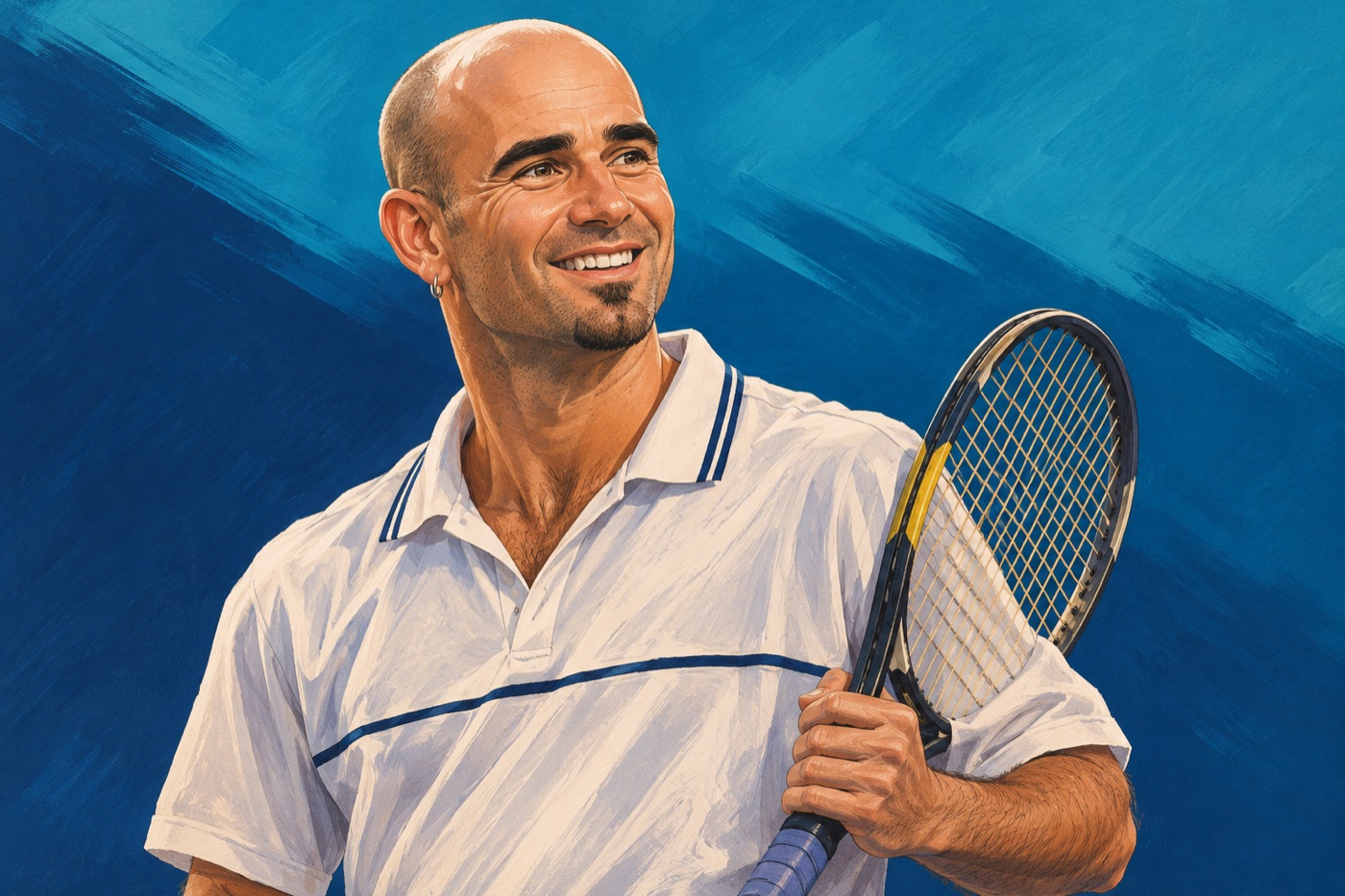
The aim of this profile is to connect a historical career with an understandable viewing exercise. It does not prescribe Agassi's technique as a universal model or claim that every short backswing produces the same result.
A career Grand Slam is not a calendar Grand Slam
Agassi won eight major singles titles, including four Australian Opens, two US Opens, Wimbledon in 1992 and Roland-Garros in 1999. Completing the collection in Paris gave him a career Grand Slam: winning each of the four majors over the course of a career. It does not mean that he won all four in one season. His men's singles gold medal at the 1996 Atlanta Olympics is a separate achievement.
That distinction matters when people discuss the greatest players. A headline can make different accomplishments sound interchangeable. A useful comparison states exactly what is being counted and acknowledges that calendar structure, playing conditions and opponents differ between eras.
Return position is a trade-off, not a badge of bravery
When a receiver stands closer to the baseline, the available reaction time changes. The returner may gain a more direct route to early contact, but also has less time to read and organise a difficult serve. Standing farther back creates a different set of opportunities and problems. Neither location is automatically the intelligent choice on every point.
Watch a complete return game. Note the receiver's starting position on first and second serves, then the contact position after the ball arrives. The two are not necessarily identical. A camera may hide the depth difference, so use court markings where possible and leave uncertain observations unclassified rather than inventing precision.
Judge the return by the server's next ball
A spectacular return winner has an obvious outcome. A return that lands deep enough to prevent an easy first attack may be valuable without looking dramatic. Conversely, a return that lands in can still leave the receiver immediately defending.
For each returned serve, ask what the server can comfortably do next. Does the ball arrive at a height and depth that supports an attacking groundstroke? Has the return opened a useful angle? Has it merely preserved the rally? Those questions turn a montage of isolated strokes into a study of the beginning of a point.
This approach also prevents an unhelpful mistake in recreational tennis: measuring return quality only by return winners. A repeatable start to the rally can be a better practice target than a low-percentage attempt to end every point immediately.
Early contact needs an organised decision
Taking time away is often described as if it were just a matter of swinging earlier. In practice, position, recognition, preparation and the incoming ball interact. Watch how much space is available around contact and whether the returner has room to control the racket face.
An editorial viewing interpretation is not a measurement of racket mechanics. A television angle cannot establish exact joint positions, grip pressure or timing. It can, however, show whether the returner appears balanced after contact and whether the next shot is played from a workable court position. Those are useful observations for deciding what to ask a qualified coach.
Make a return-game scorecard
Choose two consecutive return games from the same match. Write down serve type as first or second, whether the return is missed, whether it starts a rally, and which player seems to have the first comfortable attacking opportunity. Keep the final point winner in a separate column.
The separation is important. A useful return can be followed by an unrelated mistake, while a difficult defensive start can still end in a won point. At the end, identify one pattern to investigate in another match. Do not convert a tiny sample into a career return percentage or present an impression as a calculated advantage.
A manageable club-player experiment
With a practice partner serving at a comfortable, agreed pace, use a generous return target through the middle. Begin with the objective of starting a balanced rally, not beating the server. After a short block, discuss whether your position gives enough time to recognise the ball and prepare. Change one feature at a time so you can describe what changed.
If you move your return position and simultaneously change racket, strings and swing intention, the result becomes difficult to interpret. The same principle applies when assessing equipment: use a simple question and keep a record. Our stringing log guide applies that idea to racket setup.
Read the rivalry from both ends
Agassi's return makes an interesting companion to Pete Sampras's serve-and-first-volley pattern. Watch the same opening exchange once from the server's perspective and once from the receiver's. The point is not to prove that one historical style has become the only correct one. It is to see how one player's choices limit the other player's comfortable options.
Sources
- International Tennis Hall of Fame: Andre Agassi — major singles record and Olympic achievement.
Historical facts checked on 16 November 2026. The scorecard and practice example are original editorial suggestions, not a published analysis of Agassi's match statistics.
Related reading
- Pete Sampras: The Serve, the First Volley and a Complete Attacking Pattern
- Steffi Graf: The Golden Slam, Forehand Positioning and the Slice Backhand
- Martina Navratilova: Serve-and-Volley, Doubles and the Value of the First Step
- Chris Evert: Baseline Consistency, Clay-Court Patterns and Patient Pressure
- Roger Federer: career and playing style
- Serena Williams at Wimbledon
