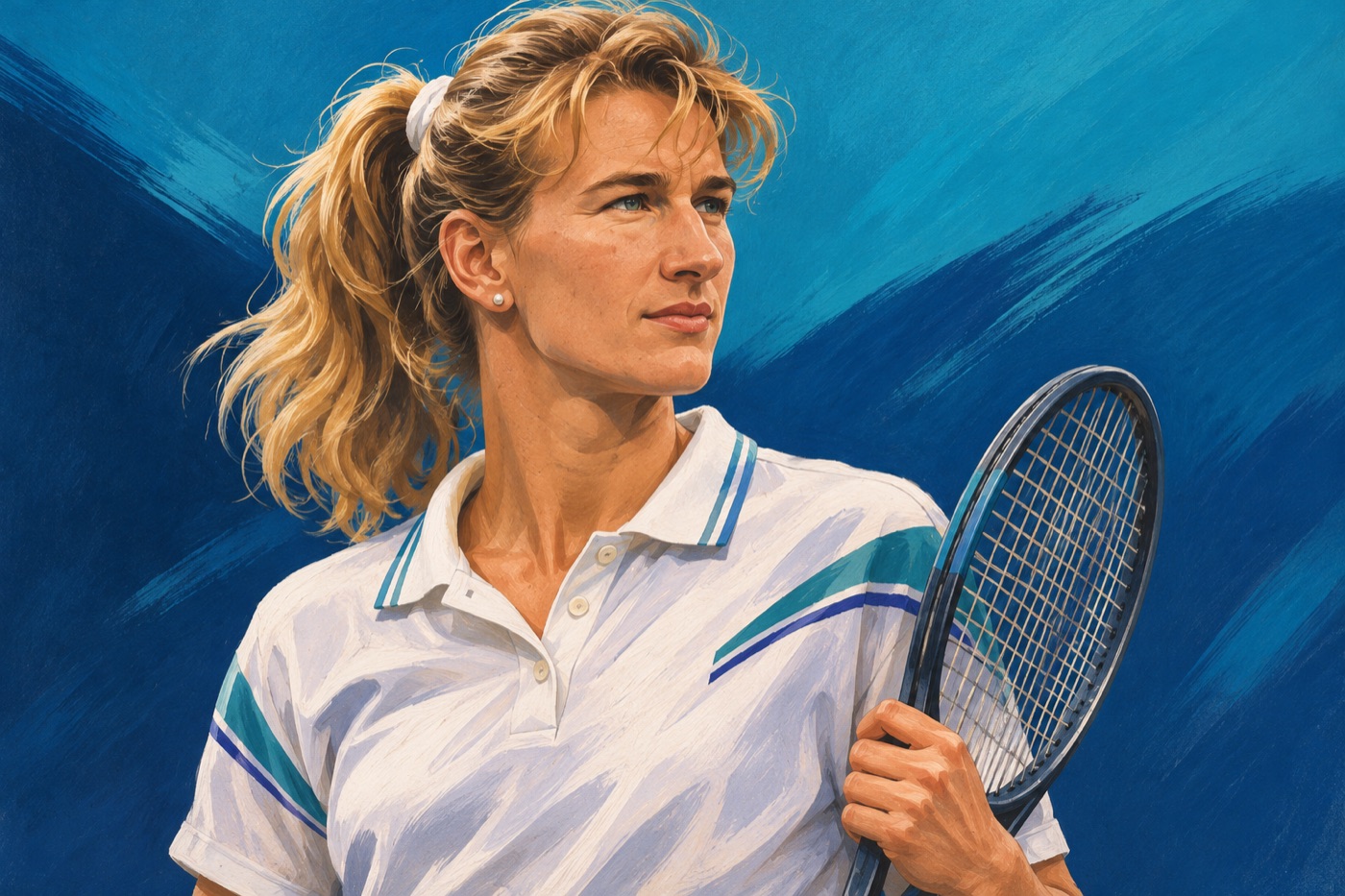
Steffi Graf's forehand is a memorable image, but a useful study of her tennis should not stop at the stroke itself. The more interesting question is how positioning creates the opportunity to use it, and what happens when the opponent sends the next ball elsewhere. Watch the movement around the shot as closely as the shot's apparent power.
This historical guide separates documented achievements from an editorial way of reading match footage. It does not claim that a professional's movement pattern should be copied unchanged by every recreational player.
What the 1988 Golden Slam means
In 1988, Graf won the Australian Open, Roland-Garros, Wimbledon and the US Open, together with the Olympic singles gold medal in Seoul. That collection within one calendar year is known as the Golden Slam. It is different from completing a career Grand Slam across several seasons.
Graf finished her career with 22 major singles titles and accumulated 377 weeks at world No. 1. Her major collection included titles on grass, clay and hard courts. These are useful historical reference points; none should be confused with the combined total from singles, doubles and mixed doubles.
The forehand begins with space
Before a forehand, watch the distance between the player and the arriving ball. A player needs room to organise contact, but moving around the backhand side also changes the court that must be covered afterward. An aggressive intention can create an opportunity and a recovery problem at the same time.
Pause a rally when Graf moves to use the forehand. Where is the opponent standing? Which part of the court is left open? Is the incoming ball slow enough to support the move? These questions are more informative than describing every forehand as an unstoppable weapon after knowing that the point was won.
Treat the slice as a different ball, not an apology
A slice backhand changes the shape of the exchange. Instead of classifying it simply as less powerful than a drive, observe its height, depth and the next contact it offers the opponent. A low ball received while moving forward poses a different problem from a short ball that sits comfortably above net height.
There is no need to pretend that every slice in a historical match had the same purpose. Some balls preserve time, some alter the rally's rhythm, and some are played because the incoming situation leaves limited alternatives. The useful habit is to connect the chosen shot with its context rather than attach one confident tactical explanation to all of them.
Recovery belongs in the assessment
Highlights tend to stop when the forehand lands. Full matches show the points where it comes back. Watch the first recovery steps and the next split step, then consider how the opponent's reply changes the available choices. A beautiful winner and an overextended attempt may begin with similar-looking ambition.
For a club player, this creates a simple practice question: can you use an attacking shot and still reach a sensible position for the reply? That question is easier to work on than trying to recreate the racket-head speed of an elite champion. The quality of the decision remains important even when a practice partner supplies a slower ball.
A three-column viewing exercise
Select one sustained rally and record three moments: the shot that creates space, the attacking contact, and the recovery position. Use ordinary language such as deep, short, wide or balanced. Do not invent centimetres, spin rates or running speeds from a broadcast image.
Now find a second rally where the same general intention does not work. Compare the preparation rather than simply labelling one decision good and the other bad. Perhaps the incoming ball was deeper, the opponent was better positioned, or there was less time to move around it. The exercise is designed to improve observation, not to produce an objective scouting report from two points.
Using a champion in a GOAT discussion
The strongest comparisons begin with a defined question. Are you comparing major singles totals, sustained ranking performance, a particular season, or success across surfaces? Graf's 1988 season is especially relevant to one of those questions, while her longer record speaks to others.
Keep interpretation separate from arithmetic. You can admire a distinctive style without claiming that one number settles every historical debate. Our profiles of Chris Evert and Martina Navratilova show why different measures reveal different kinds of achievement.
A practical lesson without a replica racket
Begin a cooperative rally with the aim of creating one comfortable forehand rather than forcing a forehand from every position. After playing it, recover for the next ball. Alternate this with a rally where you stay on the backhand side and use a dependable neutral reply. Discuss which incoming balls justified changing position.
The exercise works with suitable equipment you already understand. An endorsement model or a historical frame cannot substitute for positioning and timing. Use our racket guide if you are assessing a change, and treat any practice suggestion as something to adapt to your own level.
Sources
- International Tennis Hall of Fame: Stefanie Graf — historical achievements and major record.
Historical facts checked on 16 November 2026. The movement discussion is editorial interpretation; no biomechanical measurements or first-hand coaching relationship are claimed.
Related reading
- Pete Sampras: The Serve, the First Volley and a Complete Attacking Pattern
- Andre Agassi: Reading the Return of Serve and Taking Time Away
- Martina Navratilova: Serve-and-Volley, Doubles and the Value of the First Step
- Chris Evert: Baseline Consistency, Clay-Court Patterns and Patient Pressure
- Roger Federer: career and playing style
- Serena Williams at Wimbledon
