Consistency sounds passive until you watch how a well-placed ball changes the next decision. Chris Evert's tennis offers a useful way to study pressure built through placement, repeatable contact and patience. The point is not that every rally should last as long as possible. It is that an opponent can be made uncomfortable before a winner is attempted.
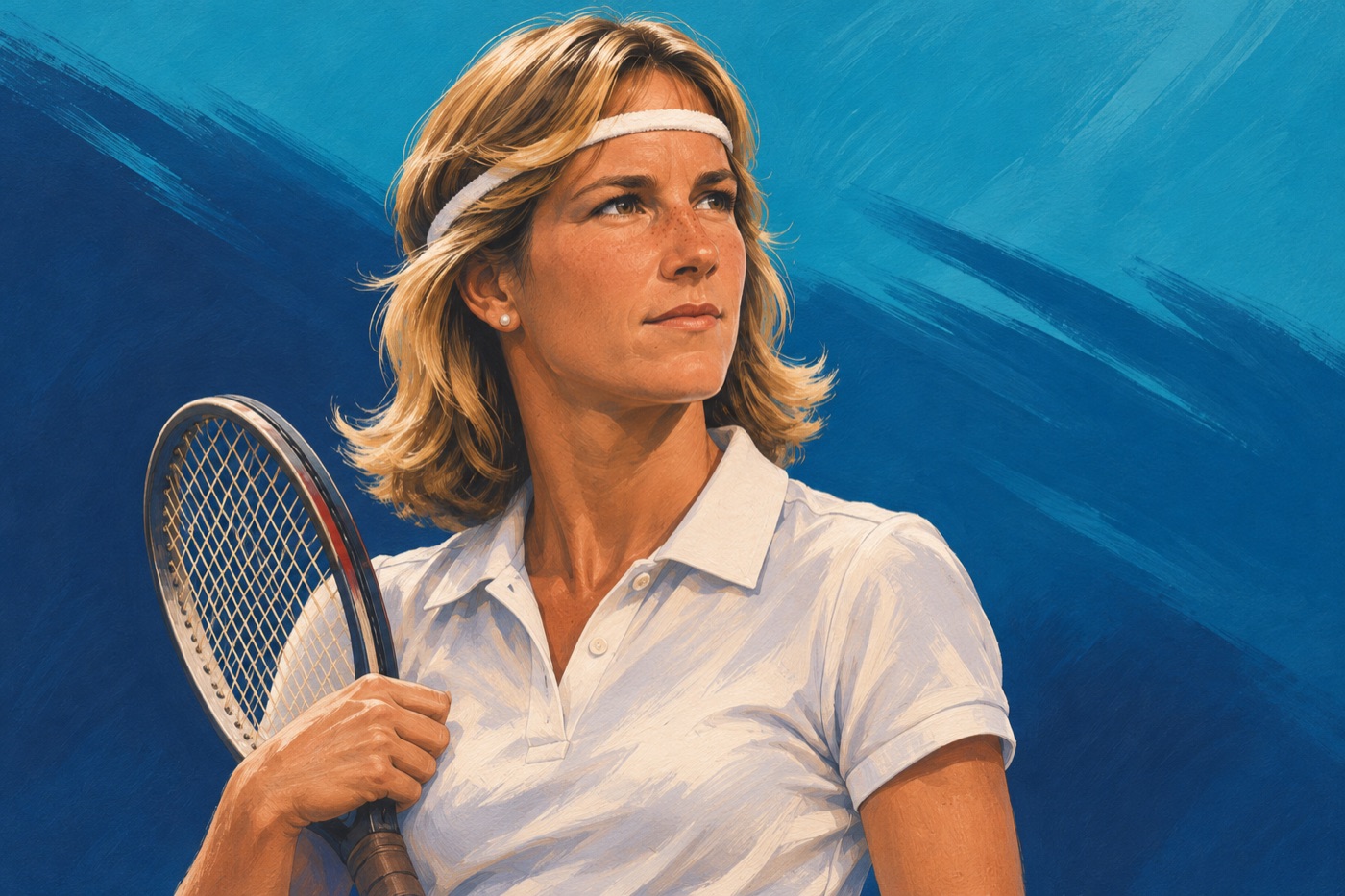
This is a historical profile and an original viewing guide. The practice ideas are intended as adaptable observations, not as a claim that Tennis Baselines has coached Evert or measured her strokes.
The record behind the reputation
Evert won 18 major singles titles, including seven at Roland-Garros. Her collection also included six US Opens, three Wimbledon singles titles and two Australian Opens. The International Tennis Hall of Fame records a 125-match clay-court winning sequence between August 1973 and May 1979.
Those facts give substance to the description of a great baseline competitor. They should also be read in their proper categories. A sequence of match wins, a major title total and a ranking achievement are different measures. A historical comparison becomes more useful when the reader knows which one is under discussion.
Depth is useful because of the next contact
Rather than treating a deep ball as automatically good, watch what it asks the opponent to do. A ball arriving close to the baseline may reduce the room for an easy attacking swing, but its height, pace and direction still matter. The same landing area can lead to different outcomes when the opponent's position changes.
Pause just before the opponent strikes. Is there space to step forward comfortably, or does the player have to organise contact while moving backward or sideways? That question reveals the purpose of placement more clearly than a label such as defensive or attacking attached after the point has ended.
Baseline patterns are not just cross-court repetition
In a longer exchange, look for the moment when the available court changes. A cross-court ball can preserve a manageable rally shape; a change down the line can create a new angle and a new recovery requirement. Neither becomes the intelligent choice simply because it produced a winner in the highlight clip.
For a recreational player, the useful lesson is to notice the incoming ball before changing direction. When contact is rushed, an ambitious new target may create more difficulty than it solves. When the opponent has been displaced and the next ball is manageable, a directional change may become easier to organise. This is an editorial framework for observation, not a universal formula.
Patience still needs an intention
Keeping the ball in play can be purposeful when it maintains depth or asks the opponent to hit from an awkward position. It becomes less useful as a practice instruction if the player stops considering placement and merely hopes for a mistake. Watch whether a repeated pattern gradually improves a position or leaves both players equally comfortable.
A good question for match footage is: what changed before the first obvious attacking shot? The answer may be a wider ball, a shorter reply, or an opponent recovering from an uncomfortable contact. The pressure can have been built several shots before the eventual point-ending stroke.
Comparing Evert and Navratilova without making a caricature
Evert's baseline identity and Navratilova's forward movement make an instructive contrast, but simplified labels hide much of the tennis. A baseliner still has to recognise opportunities to move forward; a net player still needs a useful response when kept back. Their exchanges can be studied as a negotiation over the next contact rather than a contest between two fixed slogans.
Read Navratilova's serve-and-volley profile and watch a few points from each player's perspective. Ask what ball each would prefer to receive, and which placement makes that preference harder to achieve. This gives the historical contrast a practical purpose.
A rally worksheet you can actually complete
Pick one game with several baseline exchanges. For the first five rallies, note where each player starts the exchange, the first ball that changes the opponent's position, and the first comfortable attacking contact. Keep the final winner or error separate from the shot that created the opportunity.
Use broad descriptions rather than guessed measurements. Television footage does not justify a precise speed, spin rate or distance unless a verified display provides it. Repeat the exercise with another game before deciding that your first impression represents a consistent pattern. A small notebook is a tool for better attention, not a replacement for a properly defined data set.
A patient-pressure practice idea
Start a cooperative cross-court rally with a generous depth target. Agree that a directional change is allowed only after an obviously shorter ball. The objective is to recognise the change in opportunity while maintaining balance, rather than to force a winner on a set shot count. Use a comfortable pace and adapt the space to both players' level.
After a short block, discuss which balls invited the change and which were simply tempting. That distinction is a useful lesson from studying patient tennis. For related reading, explore playing in the wind and Steffi Graf's positioning patterns.
Sources
- International Tennis Hall of Fame: Chris Evert — major singles record and clay-court sequence.
Historical facts checked on 16 November 2026. Tactical explanations and exercises are editorial interpretation, not first-hand reporting or measured performance claims.
Related reading
- Pete Sampras: The Serve, the First Volley and a Complete Attacking Pattern
- Andre Agassi: Reading the Return of Serve and Taking Time Away
- Steffi Graf: The Golden Slam, Forehand Positioning and the Slice Backhand
- Martina Navratilova: Serve-and-Volley, Doubles and the Value of the First Step
- Roger Federer: career and playing style
- Serena Williams at Wimbledon
