Pete Sampras is often reduced to a big serve and a collection of Wimbledon trophies. That description misses the decisions that made his attacking tennis work. A serve was valuable partly because it shaped the return; a first volley was useful partly because it made the next pass more difficult. Watching those connections gives a club player more to learn than simply counting aces.
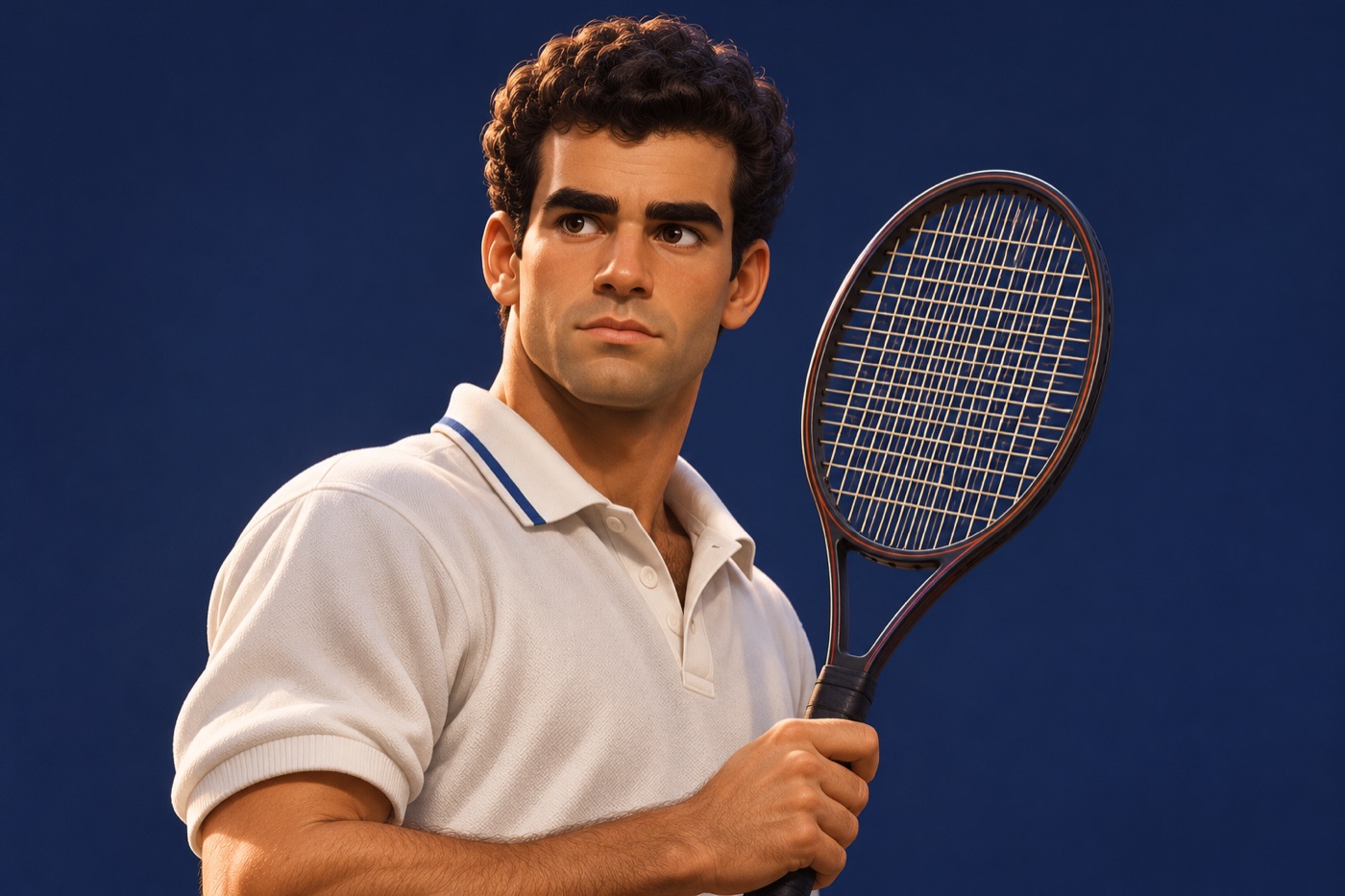
This is a historical profile and an editorial viewing guide. The exercises below are suggestions for studying tennis, rather than a claim that we coached Sampras or tested his equipment.
The career record, with the categories kept separate
Sampras won 14 major singles titles: seven at Wimbledon, five at the US Open and two at the Australian Open. His first and last major singles victories came at the US Open, in 1990 and 2002. He finished six consecutive seasons as ATP year-end No. 1, from 1993 through 1998. Those are distinct achievements: a major total measures one part of a career, while year-end ranking reflects a different competition across a season.
They also explain why he belongs in a discussion of tennis greats without requiring a supposedly objective all-era ranking. Comparing players fairly means identifying the measure before announcing the winner. Fourteen major singles titles should not be compared with another player's combined singles and doubles total.
Start watching before the ball is struck
An attacking pattern begins with choices about placement, position and the next shot. On a service point, watch where the receiver stands and where Sampras intends to move after serving. Then follow the return's height and direction. A volley struck above net height is a different opportunity from one taken around the shoelaces.
Instead of labelling every forward move a successful serve-and-volley play, separate three outcomes: an unreturned serve, a return that offers a manageable first volley, and a return that immediately puts the attacker under pressure. This makes a match easier to understand because it distinguishes the serve's direct reward from the work still required afterward.
The first volley is not always the finishing volley
A common recreational mistake is to treat arrival at the net as permission to aim for an immediate winner. A more useful viewing question is whether the first volley improves the position for the next exchange. Depth, placement and balance can matter more than theatrical pace.
Choose five points in which Sampras has to play a first volley. Pause after contact and ask where the opponent can comfortably hit the next ball. Is there a short angle available? Does the attacker still have to recover laterally? This is an observation exercise, not evidence that one prescribed volley target is correct in every situation.
Do not edit the baseline exchanges out of the story
Serve-and-volley highlights can make an attacking player appear disconnected from baseline tennis. Look at points in which the return prevents an immediate approach. Notice whether the next groundstroke maintains the rally, creates a shorter ball, or forces a hurried transition.
For a club player, the transferable lesson is preparation. A dependable neutral ball can preserve the chance to attack later. Copying the final rush forward without first creating a suitable ball makes the approach much less repeatable. An attacking identity still needs a response when the first plan is unavailable.
A ten-point viewing worksheet
Take ten consecutive service points from one match, rather than selecting only the famous ones. For each point, record serve placement, whether a return came back, the height of the first contact after the serve, and where the point ended. Add a final column for what you could not judge from the camera angle.
Review the sequence before drawing a conclusion. Perhaps the first volley mattered less than expected because several serves were unreturned. Perhaps the most difficult points started with low returns rather than unusually hard passes. The worksheet helps identify a question for further viewing; ten points are not a reliable statistical description of an entire career.
What to borrow, and what to leave with the professional
Borrow the idea of linking shots. In a comfortable practice rally, decide on a simple approach target, move forward only behind an appropriate ball, and recover into position for the next volley. Keep the exercise at a pace that allows balanced movement and clear decision-making. It is a practice suggestion, not a reproduction of professional match conditions.
Leave equipment imitation out of the first experiment. A racket associated with a champion does not automatically suit your timing or strength. Our racket history and doubles tactics guide offer useful background without promising that a particular frame or net position will transform your game.
Sources and further reading
- International Tennis Hall of Fame: Pete Sampras — historical achievements and career background.
- Andre Agassi: reading the return — a complementary way to study the opening exchange.
Historical information checked on 16 November 2026. Tactical observations and the worksheet are editorial interpretation, not measured findings from a performance study.
Related reading
- Andre Agassi: Reading the Return of Serve and Taking Time Away
- Steffi Graf: The Golden Slam, Forehand Positioning and the Slice Backhand
- Martina Navratilova: Serve-and-Volley, Doubles and the Value of the First Step
- Chris Evert: Baseline Consistency, Clay-Court Patterns and Patient Pressure
- Roger Federer: career and playing style
- Serena Williams at Wimbledon
